As the October skies clear after the monsoon, one of the most famous celestial visitors returns: a shower made of dust shed by Halley’s Comet. The Orionids are not the biggest show of the year but they are fast, bright and easy to find, because they stream out from the familiar constellation of Orion.
In 2026 there is a catch: a bright Moon will be in the sky for part of the night. This guide tells you exactly when to look, where to face and how to get the best view from Mumbai and across India.
What Are the Orionids, and Why Are They Linked to Halley’s Comet?
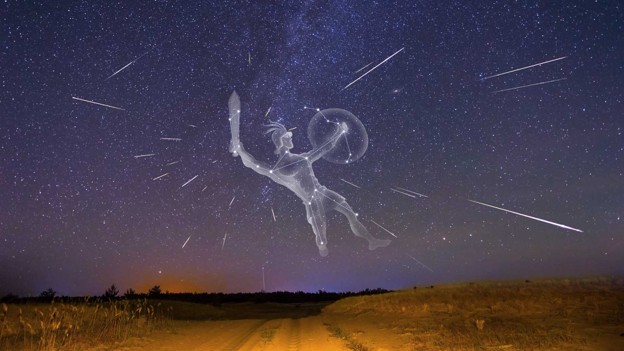
The Orionids are a meteor shower made of tiny grains left behind by Halley’s Comet, the most famous comet in history. Halley returns to the inner Solar System only once every 76 years (next in 2061), but the dusty trail it leaves along its orbit stays behind. Each October, Earth ploughs through that trail, and the grains burn up in our atmosphere as shooting stars.
Earth crosses Halley’s trail twice a year. The May crossing gives us the Eta Aquariids, and the October crossing gives us the Orionids.
Orionid meteors are known for being exceptionally fast, hitting the atmosphere at roughly 66 km/s. That speed makes them bright and often leaves glowing trains that linger in the sky for a second or two after the meteor has passed.
Join our Stargazing events at Bhandardara to view the beautiful night sky in all it’s glory.
When is the Orionids Meteor Shower in 2026?
The Orionids peak on the night of October 21–22, 2026, with the best action in the pre-dawn hours of October 22. The American Meteor Society lists this as the peak night, while some predictions place the exact maximum a little later, around mid-day IST on October 23, when it is daytime in India. In practice, the peak is broad, so the pre-dawn hours of October 21, 22 and 23 can all be rewarding.
The shower is active for several weeks, from early October to early November, but meteor counts away from the peak are low.
How Will the Moon Affect the Orionids in 2026?
Moonlight is the main challenge this year. The Moon is new on October 10 and full on October 26, so around the peak it is a bright waxing gibbous, roughly 70–80% illuminated. Moonlight washes out the fainter meteors, so expect to see fewer of them than the usual numbers suggest.
The good news is that a waxing Moon sets before dawn. From India it sets in the small hours, roughly between 2:30 AM and 4:00 AM IST on the peak mornings (check the exact moonset for your city). That leaves a dark window from moonset until the first light of dawn.
To make the most of it:
- Plan your main watch for the period after moonset and before dawn.
- Before moonset, keep the Moon behind you or hide it behind a building, hill or tree.
- Look at the part of the sky away from the Moon, not near it.
- Remember that bright Orionid meteors and glowing trains still cut through moonlight.
Where Should You Look From India?
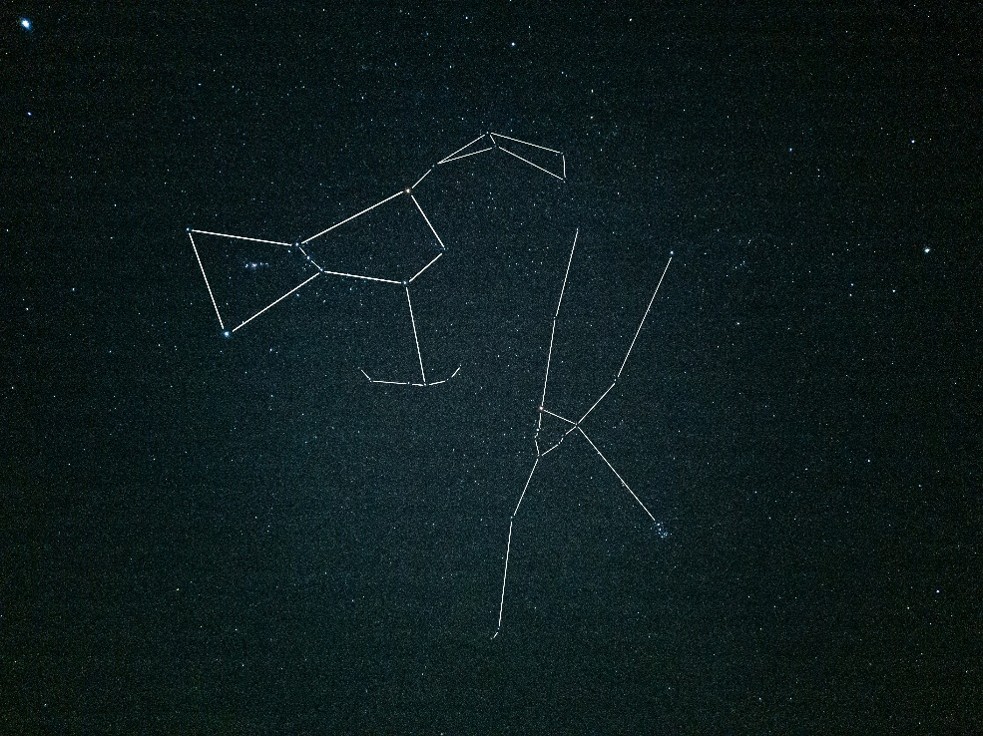
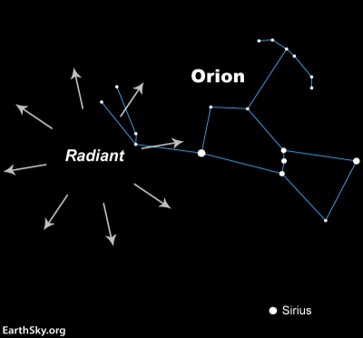
Orionid meteors appear to spread out from a point called the radiant, which sits in the upper part of Orion, near the red star Betelgeuse and close to the Orion–Gemini border. From India, Orion rises in the east, and the radiant is above the horizon from roughly 10 PM to 11 PM. It climbs steadily through the night and passes almost overhead from Mumbai-like latitudes in the hours before dawn.
A simple way to find it: look for the three bright belt stars of Orion, then move up to the reddish Betelgeuse at Orion’s shoulder.
- After midnight (before moonset): face east or north-east, with the Moon behind you.
- After moonset: lie back and take in as much of the sky as you can, centered on the area overhead and towards the east.
Stargazing Tip: You do not need to stare at the radiant. Meteors can appear anywhere in the sky, and those further from the radiant often leave longer, more dramatic trails.
Capture the Orionids with your camera and share it with @stargazingmumbai on Instagram!
What Is the Best Time to Watch the Orionids From Mumbai?
The best time is the pre-dawn window after the Moon has set, roughly 3:30 AM to 5:15 AM IST in Mumbai, before the sky begins to brighten. Unlike the Geminids, the Orionids are a late-night shower: the radiant is low in the evening and only gains height after midnight, so you will see few meteors before about 11 PM.
Under a dark, moonless sky the Orionids give around 10 to 20 meteors per hour at peak. With the Moon in the sky and a typical rural sky, a realistic expectation is a handful of meteors per hour, with a few bright ones standing out. Treat these as averages: meteors come in bursts and lulls.
Exact timings shift slightly with your city, so adjust by a few minutes if you are far from Mumbai.
Orionids Meteor Shower 2026 at a Glance
| Detail | Orionids 2026 |
|---|---|
| Peak night | October 21–22 (broad peak, October 21–23 all worth watching) |
| Hourly rate | Up to ~20 meteors/hr under dark, moonless skies |
| Parent body | Comet 1P/Halley |
| Radiant constellation | Orion |
| Speed | ~66 km/s |
| Moon | Waxing gibbous, ~70–80% lit; sets in the small hours |
| Best viewing window (IST) | After moonset to dawn, roughly 3:30–5:15 AM |
| Best direction | East and north-east, then overhead |
Essential Tips for Watching the Orionids from India
- Escape light pollution: City lights hide faint meteors, which matters even more in a moonlit year. Head to a dark-sky site for better viewing opportunities
- Use your naked eyes: Telescopes and binoculars show only a tiny patch of sky. Your bare eyes give the widest view.
- Give your eyes time: Allow 20 to 30 minutes for dark adaptation. Avoid phone screens and use a red-light torch.
- Stay warm and comfortable: Pre-dawn in October can be chilly. Pack a jacket, blanket, a flask of something warm and a reclining chair or camping mat so you can lie flat.
- Try some photography: Use a tripod, a wide-angle lens, a high ISO and long exposures of 15 to 25 seconds, pointed at the area around Orion. Meteors are random, so shoot continuously.
Watch the Night Sky and Meteor Showers with Stargazing Mumbai
Want to catch the Orionids and stargaze through professional telescopes? Book your spot on an upcoming Stargazing Mumbai tour, or join us at our stargazing sessions at Bhandardara or Mahuli for guided observation.
If you enjoyed this guide, check out our other astronomy blogs: