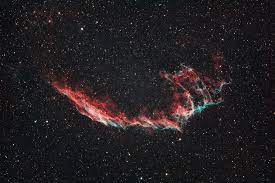
As the monsoons recede and temperatures drop across Maharashtra, the stargazing season in India comes alive again. Winter offers some of the clearest and most stable skies of the entire year making the early winter the absolute best time for skygazing. Beyond the bright constellations like Orion and Taurus, winter is packed with incredible celestial rain, the meteor showers. Enjoy reading through this comprehensive guide to understanding meteor showers and navigating the winter sky calendar.
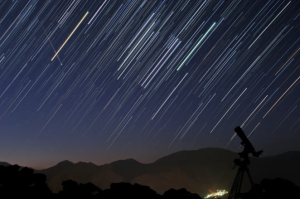
Meteor, Meteoroid and Meteorite : Get the Basics
To understand a meteor shower, get familiar with these terms first:
- Meteoroid: A small piece of space debris that ranges from tiny dust grains to pebble-sized rocks that orbit in outer space.
- Meteor: The flash of light we see in the sky and commonly called a “shooting star.” This happens when a meteoroid enters Earth’s atmosphere at extreme speeds. The intense air friction heats the particle and surrounding gas until it burns up that leaves a glowing trail.
- Meteorite: If any part of the meteoroid survives the fiery plunge and hits the ground, it is called a meteorite.
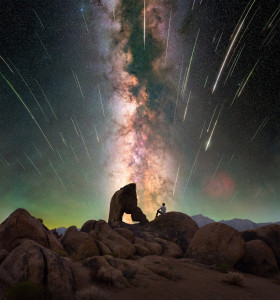
While random single meteors (“sporadic meteors”) happen every night, a meteor shower occurs when Earth passes directly through a dense trail of debris left behind by a comet or in rare cases, an asteroid as it orbits the Sun. As thousands of these tiny grains strike Earth’s upper atmosphere simultaneously, skywatchers get to witness dozens or even over a hundred shooting stars every hour.
Understanding the Meteor Radiant If you track the paths of meteors during a shower, you’ll notice a fascinating optical illusion where they all seem to streak outward from a single point in the night sky. This point is called the radiant:
Imagine standing in the middle of long and straight railroad tracks looking toward the horizon. The two parallel steel rails seem to meet at a single spot in the far distance. That imaginary focal point is the radiant. The long metal rails extending across the ground are the streaks.
Stargazing Tip: You do not need to stare directly at the radiant to see meteors. Meteors radiating from a constellation can appear anywhere in the sky, and those appearing further from the radiant point often leave longer, more dramatic trails across the dark background. In reality, space debris enters our atmosphere in parallel paths. Because of perspective, if you trace the tail of every streak backward, they will all intersect at that single point (the radiant).
Capture a meteor shower with your cameras and share with @stargazingmumbai on Instagram!
How do meteor showers get their names?
Meteor showers are named after the constellation in which their radiant point is located. For e.g., the Geminids appear to radiate from the constellation Gemini, and the Orionids from Orion.
-
Draconids Meteor Shower
The Draconids kick off the autumn-winter viewing season. Unlike almost all other meteor showers which are best viewed after midnight, the Draconids are best seen in the early evening shortly after sunset. Being a minor shower, it is an easy one for families and beginners who don’t want to pull an all-nighter.
-
Orionids Meteor Shower
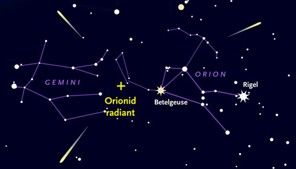
Produced by dusty debris left behind by Halley’s Comet, the Orionids are known for being exceptionally fast and bright. Peak viewing occurs after midnight when the familiar constellation of Orion rises high in the sky. These meteors can leave glowing persistent trains that linger in the sky for a few seconds.
-
Taurids Meteor Shower
The Taurids are a long-running, broad stream made of two separate components. While hourly counts are low, this shower is famous for producing “fireballs” which are extraordinarily bright and slow-moving meteors that can momentarily light up the landscape and easily punch through light pollution or moonlight.
-
Leonids Meteor Shower
The Leonids are historically famous for creating meteor “storms” every 33 years. On regular years, they produce a modest number of meteors, but their speed across the sky at 71 km/s makes them stunning to watch. Late-night observing after midnight yields the best results as Leo climbs above the eastern horizon.
-
Geminids Meteor Shower (The Undisputed King)
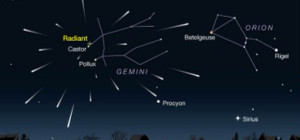
Widely considered the absolute best meteor shower of the entire year. Unlike most showers that are derived from icy comets, the Geminids originate from a rocky asteroid creating denser meteors that burn bright white, yellow, green, or blue. Because the radiant rises early in the evening (around 9:00 PM), observers don’t have to wait until pre-dawn hours to see a brilliant show.
-
Ursids Meteor Shower
The Ursids peak right around the winter solstice. It is a quiet, low-density shower radiating from near the North Star (Polaris). It is best suited for patient skywatchers in dark-sky locations who want to wrap up the year with a peaceful late-night celestial session.
Essential Tips for Observing Meteor Showers
- Escape Light Pollution: The number one enemy of stargazing is light. To see faint meteors, head to our events to dark sky destinations like Bhandardara and Mahuli.
- Ditch the Telescopes: Telescopes and binoculars magnify a very tiny patch of sky, making it almost impossible to catch fast meteors. Your bare eyes offer the widest possible view.
- Patience & Dark Adaptation: Give your eyes at least 20 to 30 minutes to adjust to total darkness. Turn off white flashlights and avoid phone screens. Use a red-light filter on torches to protect your night vision.
- Stay Warm and Comfortable: Winter nights in rural locations get cold quickly. Pack heavy jackets, blankets, thermals, and a foldable reclining chair or camping mat so you can lie flat and look up without straining your neck.
Want to see catch a glimpse of the meteor showers and stargaze with professional telescopes? Join us at our Stargazing sessions at Bhandardara or Mahuli for guided observation sessions.If you enjoyed this deep-dive into the Winter Meteor Showers, check out our other informative astronomy blogs:
- Perseids Meteor Shower 2026: Witness the Year’s Most Spectacular Meteor Shower.
- A Guide to Use a Star Map in the Digital Age.