Every November, as the nights turn cooler and clearer across Maharashtra, one of the most legendary meteor showers in history returns. The Leonids Meteor Shower are known for their speed, their bright fireballs and, once in a generation, for turning the sky into a rain of thousands of meteors a minute.
2026 is not a storm year, but it is still a good one for India. The shower peaks in the pre-dawn hours of November 18, right when Leo is high in our sky, and the Moon sets around midnight. This guide covers when to look, where to face and how to plan your night, with all timings in Indian Standard Time (IST).
Meteor, Meteoroid and Meteorite: Get the Basics
These three terms are often confused, so here is a quick guide.
- Meteoroid: A small piece of space debris, from a dust grain to a pebble, orbiting the Sun.
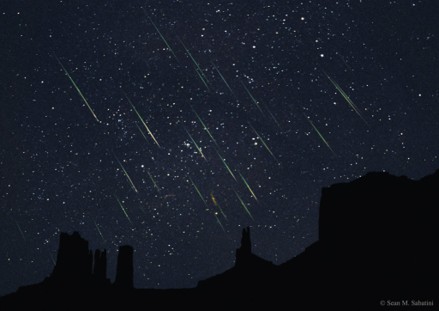
- Meteor: The bright streak we see when a meteoroid slams into Earth’s atmosphere. The glow comes from the heated air around the particle, and it is what we call a shooting star.
- Meteorite: A piece that survives the plunge and lands on the ground. Leonid grains are tiny and fragile, so they vaporise high above us.
A meteor shower happens when Earth passes through a stream of debris left by a comet. Single, random meteors (sporadic meteors) can appear on any night, but during a shower many more appear, all seeming to come from the same part of the sky.
Join our Stargazing events at Bhandardara to catch a glimpse of a meteor shower in all its glory.
What Are the Leonids, and Where Do They Come From?
The Leonids are made of dust shed by Comet 55P/Tempel-Tuttle, a small comet that orbits the Sun once every 33 years. The comet last passed close to the Sun in 1998 and is due again in 2031. Each time it comes around, it sheds a fresh ribbon of dust, and Earth passes through the old trail every November.
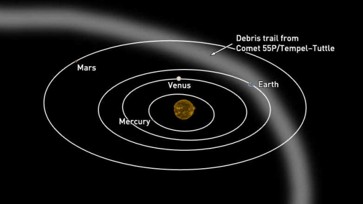
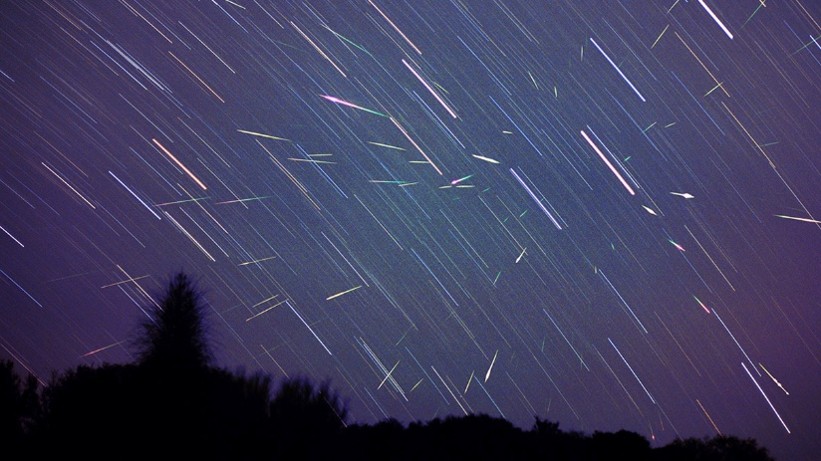
Leonids Meteor Shower are among the fastest of any shower, hitting the atmosphere at about 70 km/s. At that speed even a grain the size of a sand particle makes a bright streak, and many Leonids leave a glowing train behind them for a moment.
Try reading the book Comet by Carl Sagan and Ann Druyan to explore the scientific nature of comets, their historical and cultural portents, and their role in the origin of life and solar system evolution
Why Are the Leonids Famous for Meteor Storms?
The Leonids have a unique place in astronomy. In 1833, observers across North America saw a spectacular storm, with meteors falling like snowflakes, and it helped launch the modern study of meteors. Another storm in 1966 produced thousands of meteors per minute for a short time. Between 1999 and 2002 there were several strong outbursts as Earth crossed dense trails from the comet’s recent visits.
The pattern follows the comet: storms are most likely in the years close to its 33-year return. That is why 2026, which is some years before the next return, is a normal year and no storm is forecast. Predictions for future outbursts are uncertain, so keep an eye on astronomy news.
Visit this blog to know about the greatest meteor storms to have visited earth
When Is the Leonids Meteor Shower in 2026?
The Leonids Meteor Shower are active from about November 6 to November 30, and peak on the night of November 17–18, 2026. Forecasts place the maximum around 5:15 to 5:30 AM IST on November 18, which falls in the pre-dawn hours for India. That is good news, as the peak timing is favourable for our time zone, unlike many showers whose maximum falls in the daytime here.
The peak is fairly sharp compared to the Orionids, so the night of November 17–18 is the one to plan around. Nearby nights, especially the morning of November 17, will show lower rates.
How Will the Moon Affect the Leonids in 2026?
The Moon is at first quarter on November 17, so it is about half lit on the peak night. A quarter Moon is bright enough to wash out fainter meteors, which cuts the number you will see.
A first-quarter Moon sets around midnight, so it will not be a problem for the second half of the night. From India, expect moonset at around midnight to 1 AM IST. After that, the sky is dark until the first light of dawn. Check the exact moonset for your city using a sky app.
To make the most of it:
- Plan your main watch after moonset, from about 1 AM until dawn.
- Before moonset, keep the Moon behind you or hide it behind a building or tree.
- Avoid looking directly at the Moon, which spoils your night vision.
Watch this short video about Meteor Showers to know more about this phenomenon
Where Should You Look from India?
Leo rises late in November, and from India the radiant appears above the east-north-east horizon at around midnight to 12:30 AM IST. It then climbs steadily, and by about 5 AM it stands high in the east, more than halfway up the sky from Mumbai.
- Around midnight to 2 AM: Face east or north-east, towards the rising Leo.
- From 2 AM to dawn: Look to the east and overhead, and lie back so you can take in as much of the sky as you can.
To find Leo, look for the reddish star Regulus, the bright star at the base of the sickle. It will be low in the east after midnight, and it is a good marker for the radiant.
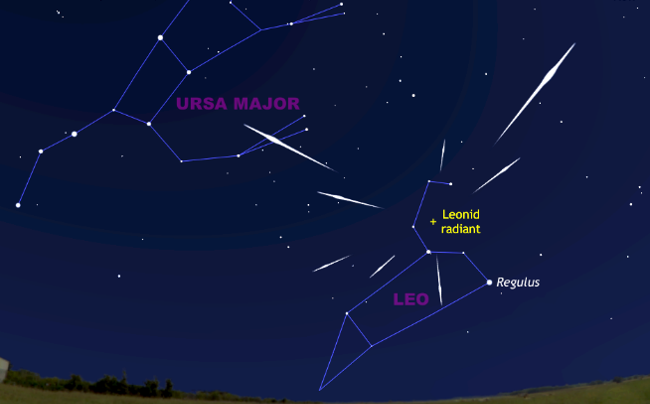
Stargazing Tip: You do not need to stare at the radiant. Meteors can appear anywhere in the sky, and those further from the radiant leave the longest trails.
What Will a Leonids Meteor Shower Look Like?
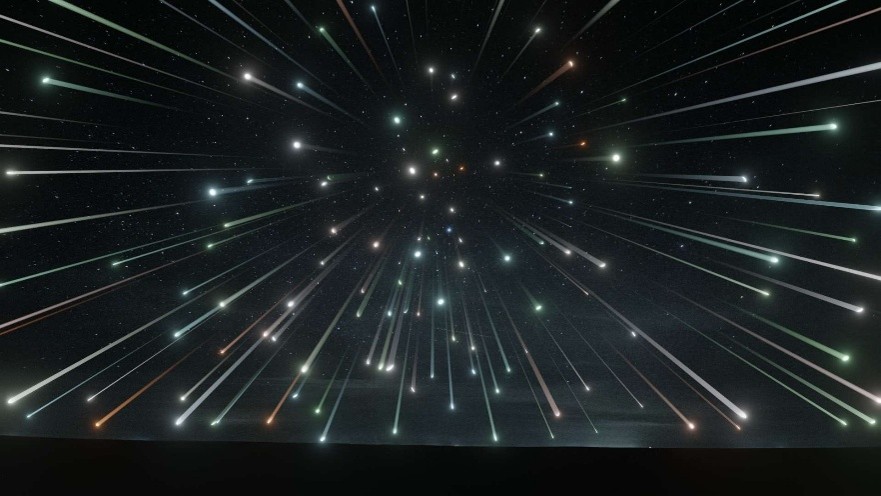
Leonids Meteor Shower are fast, bright and often leave a thin glowing train that lingers for a moment. They are well known for producing fireballs, which are extra-bright meteors that can light up the landscape.
Because Leo rises late, you also have a chance to see earthgrazers around the time the radiant rises, between about midnight and 2 AM. These are long, slow-looking meteors that skim the upper atmosphere and glide across the sky from the horizon, and they are some of the most beautiful meteors you can see.
The Leonids are not a dense shower in most years, so there will be gaps between meteors, and sometimes two or three will come in quick succession. That is normal, so settle in and keep watching.
Leonids 2026 at a Glance
| Detail | Leonids 2026 |
|---|---|
| Active period | About November 6–30 |
| Peak night | November 17–18 |
| Predicted maximum | Around 5:15–5:30 AM IST on November 18 |
| Hourly rate | About 10–15 meteors/hr under dark skies |
| Parent body | Comet 55P/Tempel-Tuttle (33-year orbit) |
| Radiant constellation | Leo |
| Speed | About 70 km/s |
| Moon | First quarter; sets around midnight to 1 AM IST |
| Best viewing window (IST) | About 2:30 AM to 5:15 AM |
| Best direction | East and north-east, then high in the east and overhead |
Essential Tips for Watching the Leonids From India
- Escape light pollution: City lights hide faint meteors. Head to a dark-sky site like Bhandardara or Mahuli.
- Use your naked eyes: Telescopes and binoculars show only a tiny patch of sky, and your eyes give the widest view.
- Give your eyes time: Allow 20 to 30 minutes for dark adaptation. Avoid phone screens and use a red-light torch.
- Stay warm and comfortable: Nights in rural Maharashtra turn chilly before dawn in November. Pack a jacket, blanket, thermals and a reclining chair or camping mat so you can lie flat.
- Be patient: Meteors come in bursts and lulls, so give it at least an hour or two.
Capture the Leonids with your camera and share it with @stargazingmumbai on Instagram!
How Can You Photograph the Leonids Meteor Shower?
You need a camera that can take long exposures and a sturdy tripod.
- Lens: Use the widest lens you have, ideally 14–24 mm, with the aperture fully open.
- Exposure: Try 15 to 25 seconds at ISO 1600–3200.
- Framing: Point the camera towards the east, including Leo or an interesting foreground such as a hill or tree. For earthgrazers, include the low eastern horizon.
- Focus: Switch to manual focus and set it on a bright star before the night begins.
- Keep shooting: Use an intervalometer or lock the shutter, and take hundreds of frames. Meteors are random, so the more frames you take, the better your chances.
Watch the Leonids With Stargazing Mumbai
Want to catch the Leonids and stargaze through professional telescopes? Book your spot on an upcoming Stargazing Mumbai tour, or join us at our stargazing sessions at Bhandardara or Mahuli for guided observation.
If you enjoyed this guide, check out our other astronomy blogs: