Did you know a rock from space once slammed into Earth with enough force to punch a hole almost two kilometers wide?
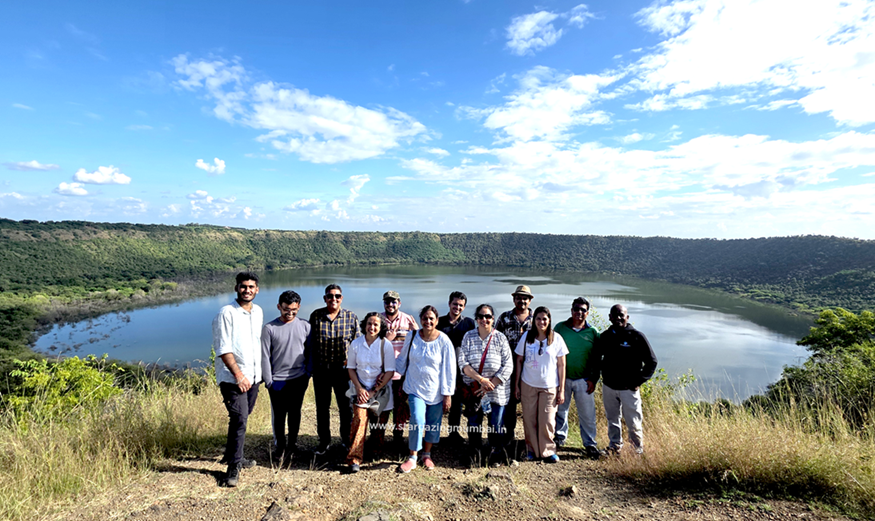 It happened long before anyone built a single road, and that scar is still there today, The Lonar Crater. Located in the Buldhana district of Maharashtra, wrapped in forest and surrounded by ancient stone temples. Most Mumbaikars drive to Lonavala or Alibaug without a second thought. Lonar just sits about 500 km east, and it offers a different kind of getaway.
Whether you are a person who loves travelling, intrigued by Indian architecture, passionate about science, and have a great interest in astronomy, this is going to be a perfect guide for you.
It happened long before anyone built a single road, and that scar is still there today, The Lonar Crater. Located in the Buldhana district of Maharashtra, wrapped in forest and surrounded by ancient stone temples. Most Mumbaikars drive to Lonavala or Alibaug without a second thought. Lonar just sits about 500 km east, and it offers a different kind of getaway.
Whether you are a person who loves travelling, intrigued by Indian architecture, passionate about science, and have a great interest in astronomy, this is going to be a perfect guide for you.
What Is Lonar Crater?
The Lonar Crater is a meteorite impact crater formed in the Buldhana district of Maharashtra. According to NASA’s Earth Observatory, the crater measures roughly 1.8 km across and about 150 m deep. The rim of the crater rises around 20 m above the surrounding land, so from a distance you would barely notice it. You can only understand what you are looking at when you reach the edge, and the ground suddenly drops away.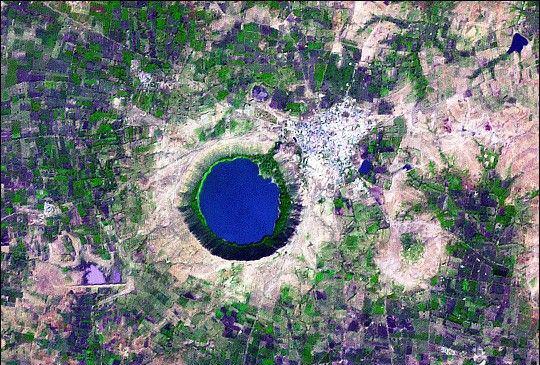 Here is a surprising fact; this is the only known impact crater till date on Earth, cut entirely into basalt. Interesting, right? A space rock hits a volcanic landscape and leaves a perfect bowl behind. Inside this Crater sits the Lonar Lake, a saline and highly alkaline body of water with no outlet. Because nothing flows out, minerals keep concentrating as the water evaporates. That is why the lake is so salty.
How was Lonar Crater Formed?
Here’s where science gets exciting. Long before the impact, volcanic eruptions spread thick layers of basalt, which is a dark, fine-grained rock created when lava cools across much of the Deccan region. Then came the impact. An object travelling at extraordinary speed struck the rocky surface, and in an instant, the rock turned to dust; shock waves fractured the surrounding surface, creating a broad depression. The walls then slumped inward, and the final shape settled into the bowl we know today. You will be amazed to know that the crater is slightly oval rather than perfectly round. That’s usually a clue that the object came in at an angle, somewhere around 35 to 40 degrees by some estimates. Over time, the water collected in the depression. Dissolved the minerals that accumulated, which helped to create the lake’s unusual chemistry. So how old is it? Well, that depends on who you ask. For decades, the accepted figure was about 52,000 years and according to 2010 study using argon-argon dating, it was pushed to roughly 57,000 years. The Buldhana district administration’s Lonar Crater Information also discusses the crater’s geological significance and the differing estimates of its age.When was Lonar Crater Discovered?
 British officer C. J. E. Alexander reported the crater in 1823, bringing it to wider attention among European observers and scientists.
Its circular shape initially raised questions about its origin. Many geologists assumed it was a volcanic crater because it sits on volcanic rock. Then in 1896, G.K. Gilbert noted its resemblance to Arizona’s Meteor Crater. The argument between “volcano” and “meteorite” ran for most of the next century.
British officer C. J. E. Alexander reported the crater in 1823, bringing it to wider attention among European observers and scientists.
Its circular shape initially raised questions about its origin. Many geologists assumed it was a volcanic crater because it sits on volcanic rock. Then in 1896, G.K. Gilbert noted its resemblance to Arizona’s Meteor Crater. The argument between “volcano” and “meteorite” ran for most of the next century.
Why Scientists Study Lonar?
Lonar is scientifically valuable because it provides a relatively accessible place to study how high-speed impacts affect basaltic rock. NASA’s Earth Observatory feature on Lonar Crater includes satellite imagery and describes the crater’s dimensions and geological evidence. It helps show how clearly the circular feature stands out in the surrounding landscape and provides a useful comparison for understanding impacts on volcanic surfaces elsewhere in the Solar System. One important clue is maskelynite in the rocks here. It is a glassy mineral formed only under extreme shock pressure, so it is strong proof that helped scientists and researchers to distinguish the impact structure from an ordinary volcanic crater. Not only that, the Lonar Crater is more like a Living Laboratory; the lake’s chemistry often attracts astrobiologists interested in studying the organisms that tolerate high salinity or alkalinity. The PH level of the water is extreme, close to 11 in some places, yet life thrives here, including the microbes that fix nitrogen.
Guess what happened in June 2020?
Not only that, the Lonar Crater is more like a Living Laboratory; the lake’s chemistry often attracts astrobiologists interested in studying the organisms that tolerate high salinity or alkalinity. The PH level of the water is extreme, close to 11 in some places, yet life thrives here, including the microbes that fix nitrogen.
Guess what happened in June 2020?
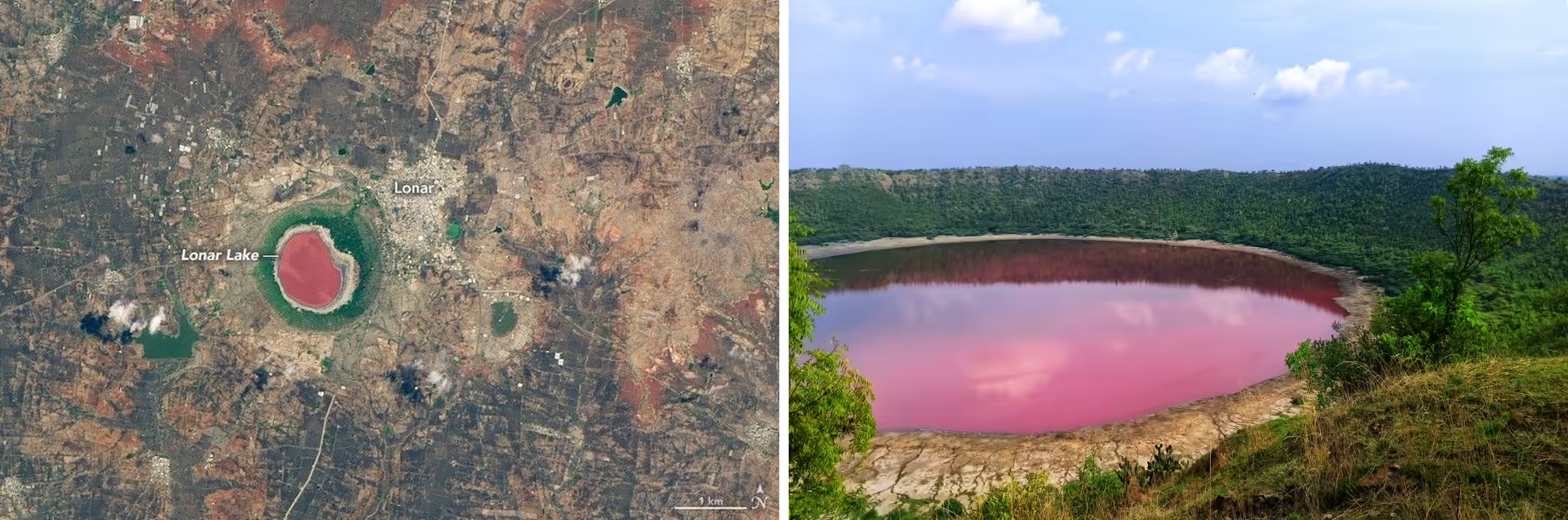 The lake turned bright pink almost overnight. NASA’s Satellite images show the color shift in just a few days. Studies pointed to haloarchaea, salt-loving microbes that release a red pigment when the water gets very salty after low water levels and the heat concentrated in the lake. It later returned to its usual green color. Sounds interesting, right?
But that’s not it! Lonar Crater is not only for the Science nerds. It is also well known for its historic temples, connecting the region to centuries of worship, local tradition, and craftsmanship.
The lake turned bright pink almost overnight. NASA’s Satellite images show the color shift in just a few days. Studies pointed to haloarchaea, salt-loving microbes that release a red pigment when the water gets very salty after low water levels and the heat concentrated in the lake. It later returned to its usual green color. Sounds interesting, right?
But that’s not it! Lonar Crater is not only for the Science nerds. It is also well known for its historic temples, connecting the region to centuries of worship, local tradition, and craftsmanship.
Temples and Sightseeing Around Lonar Crater
The Daitya Sudan Temple is one of Lonar’s best-known heritage sites, and it is famous for its stonework and sculptural details. Take a moment to look beyond the main shrine. Carvings, pillars, and decorative details can reveal the skill of the artisans who worked with stone long before modern construction equipment existed.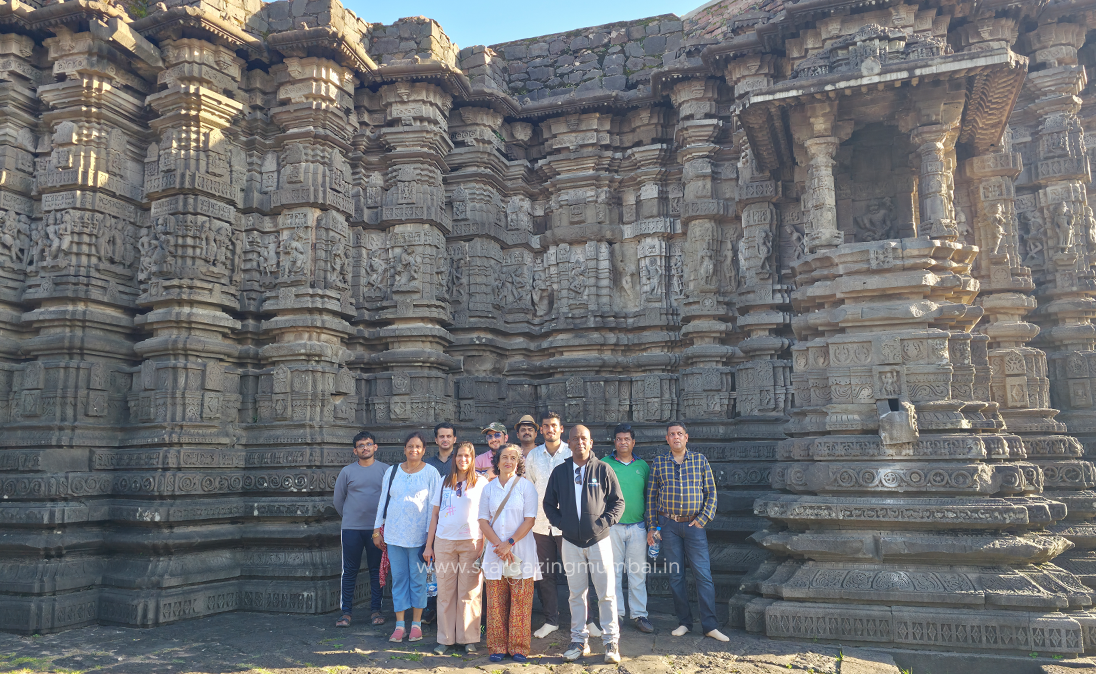 Other famous temples include the Kamalja Devi Temple, the Mor Mandir, and the Gomukh temple, where a spring flows from a stone carved like a cow’s mouth. If you walk slowly while circling the lake, you will notice something lovely. The temples sit at different heights and in different styles, so the walk feels like moving through layers of time.
More than a geological wonder, Lonar Crater, the lake, and the forest around it are part of Lonar Wildlife Sanctuary; it supports birdlife that includes peafowl, parakeets, and seasonal visitors. What you will see depends on the season, time of the day, and the local conditions, so carry binoculars with you.
Other famous temples include the Kamalja Devi Temple, the Mor Mandir, and the Gomukh temple, where a spring flows from a stone carved like a cow’s mouth. If you walk slowly while circling the lake, you will notice something lovely. The temples sit at different heights and in different styles, so the walk feels like moving through layers of time.
More than a geological wonder, Lonar Crater, the lake, and the forest around it are part of Lonar Wildlife Sanctuary; it supports birdlife that includes peafowl, parakeets, and seasonal visitors. What you will see depends on the season, time of the day, and the local conditions, so carry binoculars with you.
Astro Tour at Lonar Crater
Now here comes your favourite part. Stargazing at Lonar. When was the last time you stood outside at night and simply looked up, and how many stars did you find? Far away from Mumbai’s glow. Lonar is a small town in rural Maharashtra. Once the sun sets and the lights go out, the sky opens up. On a clear night, you can easily pick out constellations, bright planets, and soft bands of the Milky Way. As winter approaches and the meteor season starts, if you are lucky enough, you might also catch a meteor streaking across the dark sky. A few tips to keep in mind while planning your trip to Lonar Crater
- Pick a clear, dry night. Winter is the best.
- Check the Moon Phase, because a bright Moon can wash out faint stars.
- Carry a red torch and a warm jacket.
- Give your eyes about 20 min to adjust.
- Download a free sky map before you lose the signal.
- By road: Roughly 500 km, about 9 to 10 hours, usually via Aurangabad (now Chhatrapati Sambhajinagar) and Jalna.
- By train: Take a train from Mumbai to Jalna, and then taxi or bus for the last leg.
- By air: Fly to Aurangabad, which is around 140 km from Lonar, and then hire a cab.
- From Pune: Around 380 km by road.