Looking up at the night sky, it’s quite easy to mistake a planet for just another star. However, planets like Mars and Jupiter are staring right back at you, waiting for you to find them, and today, reading this will help you distinguish between them without needing a telescope!
Spotting planets in the sky is a fascinating experience, and let’s the actual distance between us and other planets sink in (while also allowing you to look cool in front of others!)
Which Planets Can You See Without a Telescope?
Planets such as Mars, Venus, Mercury, Jupiter, and Saturn are all visible to the naked eye because they are bright and can be distinguished from the others by a few differences they have. Mercury, however, can be hard to spot due to its proximity to the Sun and due to the glare caused by the Sun during its setting and rising. We need a telescope to see Neptune and Uranus.

credits: Gianluca Masi— The Virtual Telescope Project)
Best Time to Observe Planets
The best time to observe planets is determined by where they appear in the night sky, relative to the position of the Earth and the sun. They are best visible during:
credits: Astronomy NMSU
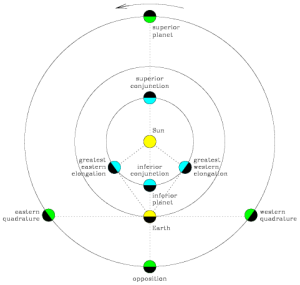
Elongation (for the inferior planets): This is when an inferior planet is farthest from the sun and thus best visible. This is determined by the angular distance between the planet and the sun, with respect to Earth.
Opposition (for the superior planets): This is a certain position when a (superior) planet is on the opposite side of the sky from the sun, thus closest to Earth, and visible due to it being at its brightest.
Planets may also not be visible in the night sky sometimes due to being too close to the Sun in our sky, overwhelmed by the Sun’s glare, and setting along with the Sun.
credits: timeanddate.com
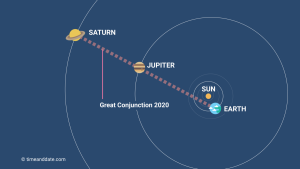
Another rare event that occurs when two or more celestial objects (here, planets) appear close to each other in the sky, even though they might be distant in space, is known as a Conjunction. A recent example of this conjunction is the planetary alignment of this year, in which multiple planets could be seen in a small area of the night sky.
You can also use apps like Stellarium Mobile, SkySafari, Star Walk 2, Sky Map, etc., to spot planets easily (along with stars and other celestial objects). Click here to find more applications for your stargazing journey.
How to Distinguish Between Planets and Stars
It’s easy to confuse a star for a planet when looking at the sky or vice versa, as they both appear similar. But we all know that stars twinkle, and this is a quick rule of thumb to remember when looking for planets: Stars twinkle, and planets don’t. Remember ‘Twinkle, Twinkle, Little Star’?
This is because stars are far away from us, and due to this, point sources of light, which get distorted and change along with the Earth’s atmosphere. However, planets are closer to us and also have a larger area, leading to them being less affected by the distortion.
This means that in space (past our atmosphere), stars would not twinkle too! Planets may also sometimes appear subtly brighter, bigger, and disc-shaped in comparison to the stars since they’re closer to us.
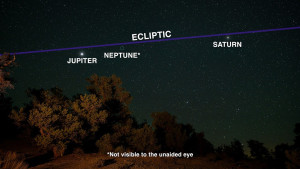
The planets also move more across the sky in comparison to the stars, which seem relatively fixed. Also, planets follow the ecliptic path, which is the path the Sun follows in the sky. Since all of them move around the Sun in almost the same plane, they also follow the same path. To find the ecliptic path, we can observe the Sun during the day and then try to map the same path in the night sky.
Finding Each Planet in the Sky
credits: NASA
Mercury: This is one of the most difficult planets to spot. Make sure you have a clear view of the horizon since Mercury is visible only during twilight (shortly before sunrise in the east or after sunset in the west).
The best time to view it is when it’s at its greatest elongation, i.e,. farthest from the Sun. It has a whiteish hue and might be dimmer in comparison to the other planets due to it always being visible on the horizon (since the light has to pass through more air).
Venus: Venus appears the brightest out of all the planets in the solar system, following the Sun and the Moon, which is why it is called the “morning star” or the “evening star”, based on when it appears in the sky. It is also usually visible just for some time after sunset or before sunrise, and appears disc-shaped, with phases, just like the moon. (Learn how these phases of Venus proved the ancient philosophers wrong.)
Mars: Being the “red planet”, it appears as a bright reddish-orange point in the night sky. It is also very bright and comes after Venus in brightness. Well, sometimes, i.e., every two years when it is in opposition. Jupiter, at other times, can appear brighter than Mars.
Jupiter and Saturn: These are usually harder to distinguish by the naked eye, but they also appear close to the ecliptic path as bright, yellowish, non-twinkling points of light in the night sky. For a beginner, it is advisable to use an app like Stellarium or Starwalk to find these planets. These can be distinguished from stars when the moon is up in the sky at a distance from them, which makes the stars invisible, but the planets may still be visible.
Using the Moon and Star Constellations

credits: timeanddate.com
We can also use the Moon as a reference to find the ecliptic! The path of the moon’s orbit is inclined 5 degrees to the ecliptic plane, which means that the planets always lie within 5 degrees of it. We can roughly measure this by holding our hand at arms length: a fist is roughly 10 degrees, three fingers held together is roughly 5, while the pinky is said to be 1 degree. Look at the image below:
Helpful Tools and Resources
As mentioned before, apps like Star Walk 2, Stellarium, etc., can be very useful and make it convenient to spot planets quickly in the sky. However, another website that can be used for this is timeanddate.com, which shows the times at which a planet will rise and set on a particular day, along with its proximity to the Sun and visibility. All of these also have an interactive night sky map that shows the sky according to your current location.
Find more applications that can help you in your stargazing journey here.
A telescope, or even a pair of binoculars, is not necessary for you to begin your journey of stargazing. Trying to spot planets in the night sky is an excellent way to enter this fascinating world and to begin familiarizing yourself with the night sky. So, the next time you’re under the vast, dark skies, look up and spot as many planets as you can!
Got a new pair of binoculars? Try finding these objects in the night sky!
Want to get a closer look at the planets and the stars through a telescope?
Take a look at our upcoming events and sign up!
If you liked this blog, check out these too:
- Best Time to See Milky Way Galaxy in India, 2025
- Orion Constellation: The Most Famous Hunter in the Sky
- Are the telescopes and binoculars necessary for an amazing stargazing night?