
Astronomical Events in November has plenty to offer for anyone who enjoys watching the night sky, covering 2 Taurid meteor shower peaks, the return of the Leonid meteor shower, a close appearance of Mars and Jupiter, and a Full Moon appearing close to the Pleiades star cluster.
Some of these beautiful events can be observed with just the naked eye, given clear skies and if you manage to be in a spot with very little light pollution. Let us look more into each of these events and a guide to watch and enjoy them.
November 5-6: Southern Taurid Meteor Shower
A small astronomical event in November to start with; the Southern Taurid is expected to peak during November 5-6. These are not known for producing a huge number of showers, but an occasional bright fireball which leaves a streak across the sky can be seen. So you should not expect a constant display, but if you are in the perfect location you can spot a meteor or two.
Viewing tip: This can be viewed with the naked eye, but just find a dark location and look up over a wide area of the sky.
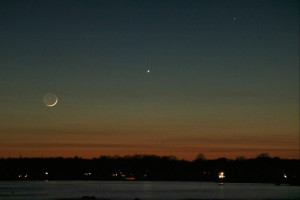
November 7-10: Venus, Spica and the crescent Moon
When we look towards the eastern sky before sunrise, Venus, one of the brightest objects in the night sky, will appear near Spica, a bright star in the Virgo constellation. Around November 7th, the thin crescent Moon also joins them.
Photograph opportunity: It will be a nice opportunity for people who enjoy photographing the sky. Venus and Moon appear, but it will be harder to notice Spica as the sky brightens out. This is one of the best astronomical event if you are new to photography. Get your amazing clicks and tag us on out instagram handle @stargazingmumbai
For this, choose a location with an unobstructed eastern horizon and enjoy the show.
November 9: New Moon
Around this time, the Moon reaches its new phase and since the moonlight will be less during this, it will be a great opportunity for observing faint stars and deep-sky objects.
Stargazing tip: If you are planning for stargazing nights, then the days around the new Moon are worth considering.
November 12-13: Northern Taurid Meteor Shower
Following the Southern Taurid Meteor Shower, the Northern Taurid Meteor Shower is expected to peak around November 12. The astronomical event is usually known for a higher number of bright meteors than Southern Taurid showers.
There is a chance of overlap of two Taurid showers, giving a higher chance to look for meteors, but we shouldn’t expect a constant spectacular show.
Best way to watch: For the best chance, go to a dark location and get your eyes adjusted to the darkness for a better chance to spot the showers.
November 14 – December 2: Four planets in the morning sky
This is one of the most interesting astronomical event to watch out for in this winter season. We can spot 4 planets of our solar system in the early morning sky: Mercury, Venus, Mars and Jupiter.
Although they are perfectly straight in space, they will appear spread along the same general path across the sky. Venus and Jupiter will be easy to spot, Mars will be reddish and Mercury will sit near the horizon, so it will be a little tricky to spot it.
Best time to watch: This astronomical event is a good test for naked-eye observation. Try looking about 40 minutes before sunrise, starting from mid-November. If you have binoculars, you could use them for even crisper and clearer observation.
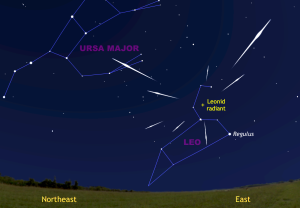
November 17-18: Leonid Meteor Shower
This is also one of the most anticipated astronomical events in November. Leonids are associated with Comet Tempel-Tuttle and are known for their fast-moving meteors. They produced some remarkable showers in the past few years, but the display rate is unusual. A major storm is not expected every year.
The 2026 peak falls around the night of November 17-18. The expected rate is modest, so patience is very important to view them. They can appear anywhere in the sky, even though they seem to radiate from the constellation Leo.
How to watch: A dark location outside the city is the best place to watch it. Please be patient since there can be long gaps between meteors, followed by a few appearing close together.
November 20-21: Mercury at greatest elongation
Mercury is very difficult to observe since it stays close to our Sun in the sky. But around November 20-21, it reaches the greatest western elongation, meaning it will be at its greatest angular distance west of the Sun.
It takes little searching to actually spot it, but this will be your best chance. Try spotting it before sunrise by looking low in the eastern sky. Use binoculars for easy searching, but never look directly at the Sun.
November 24: Full Moon
The Moon will be full on November 24th. November’s full Moon is called the Beaver Moon. It will be visible from late evenings till very long nights.
Photography Tip: For the most lovely sight, try watching it during a clear evening sky, especially when it’s close to the horizon, it appears large against the foreground. This astronomical event provides a great opportunity to photograph the moon

November 25-26: Uranus at opposition
Uranus reaches opposition around November 25-26. Opposition occurs when Earth lies roughly in between a planet and the Sun, placing the planet opposite to the Sun in the sky.
So, this is the best chance to view Uranus through the night. It is not as bright as other closer planets, but under very dark skies this can be viewed with an unaided eye. But having binoculars makes it easy to find, and with a telescope you could even see its small, pale blue-green disk.
Additional tips before you head out to stargaze
You don’t need very expensive equipment to enjoy most of these events. Keep your expectations realistic, head out to a dark location with clear skies and enjoy the grandeur.
To make it even better, you could use binoculars, telescopes and, for the best experience, you can join in one of our stargazing events.
Check out this link for more details about our events. Stargazing Mumbai Upcoming Events


