
August’s total solar eclipse may be hard to top, but September still has plenty of astronomical events in store. Throughout the month, several planets will line up with the Moon, and Venus will reach a point when it shines at its brightest. September also brings the arrival of autumn in the Northern Hemisphere, making it an excellent period for viewing the aurora. Around the equinox, Earth’s changing orientation can increase the chances of witnessing vivid and powerful displays of the northern lights.
September is also a month of Harvest in traditional history. It marks the end of summer and the start of Autumn. The word September has been derived from the word “septem” in Latin, which translates to “seven”. It was the seventh month in the calendar before January and February were added to the beginning of it.
What’s special about September’s astronomical events?
September is a particularly exciting month for skywatchers and astronomy enthusiasts, offering a variety of spectacular celestial events. The Moon will meet several bright planets, Venus will shine at its peak brightness, and the autumnal equinox will mark the seasonal transition. Longer nights also create better opportunities for stargazing, while the equinox period can bring increased chances of witnessing beautiful auroras.
September 1: Saturn is near the waning gibbous moon.
The yellow ring lord is visible near the waning gibbous moon in the evening sky. Saturn is placed in the eastern sky, visible at night from 8 PM IST. A thumb rule to know that you have spotted a planet is that it does not appear to be twinkling in the sky.
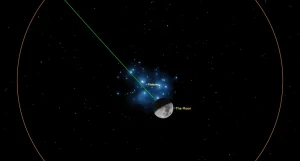
September 3: Moon appears near Pleiades
credits: Chris Vaughan/Starry Night
Watch out for the seven sisters in the south-eastern part of the sky a few hours before sunrise. The seven sisters are placed in the constellation of Taurus. A telescope will help to view the open star cluster in its full glory.
Read more about the Pleiades, aka “the Seven Sisters”: The Curious Case of Pleiades
September 7: Moon Conjunction with Mars
In the early hours of September 7th, the crescent Moon and Mars will appear close together in the pre-dawn sky, separated by about three degrees or roughly pinky finger width at hand distance. Look toward the eastern horizon around 3 a.m. local time to the red fiery planet and the Moon. Approximately 90 minutes later, Jupiter will rise behind the pair, while Saturn will be visible toward the southwest. All four planets should remain observable until sunrise.
Bonus: You can also spot bright stars like Capella and Betelgeuse. Make sure to distinguish between Mars and Betelgeuse, which appear a bit similar in their positioning and twinkling. Stars appear to twinkle, but planets don’t. Betelgeuse is in the constellation of Orion, and Capella is in the constellation of Auriga.
September 14: Conjunction of Moon and Venus

On September 14th, shortly after sunset, a thin crescent Moon will appear within about five degrees of Venus, roughly the width of three middle fingers held at arm’s length, above the western horizon. Unlike the planet-Moon pairings earlier in September, this event can be enjoyed without waking up before dawn. The Moon and Venus will remain visible and striking for about an hour after sunset before disappearing below the horizon.
September 18: Venus Reaches its peak Brightness
On the evening of September 18, Venus will reach its brightest magnitude for its entire 2026 evening apparition—and one of its most vivid points in the year. It will reach a magnitude of -4.8, which won’t look much different from the nights before or after. (For reference, the full moon is about magnitude -12.) That said, it’s still worth keeping an eye on. Due to its luminosity, Venus is one of the easiest sights in the sky to find, even in bright cities. It will appear just after sunset near the western horizon. Bonus tip: Don’t miss Mercury beside it.
September 22: Autumnal Equinox
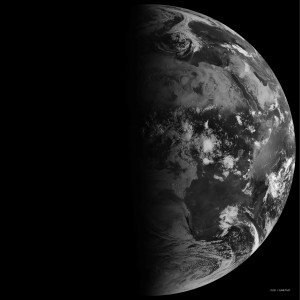
September is not only a month of fascinating celestial sights; it also welcomes autumn to the Northern Hemisphere.
On the day of the equinox, the Sun moves across the celestial equator, resulting in almost equal periods of daylight and night around the world. Afterwards, the Northern Hemisphere will gradually experience shorter days and longer nights, marking the onset of the winter season.
For astronomy enthusiasts, this seasonal shift brings an exciting advantage: more hours of darkness to observe the night sky. The longer nights offer plenty of opportunities to spot stars and planets, while the period around the equinox can also be favourable for witnessing colorful auroras.
September 2026 promises to be an exciting month for skywatchers, with close encounters between the Moon and several planets, dazzling views of Venus, and the arrival of winter with the autumnal equinox. From Saturn, Mars, Jupiter, and Venus, the night sky offers plenty of opportunities to step outside and look up. As autumn begins and nights grow longer, the chances of spotting stars, planets, and even the aurora increase. Whether you are an experienced astronomer or simply curious about the cosmos, September is a perfect reminder that some of the most spectacular sights can be found by simply looking toward the sky.


