Over the past few days, WhatsApp University and Instagram have once again gone into overdrive, flooding timelines with messages and reels claiming a “once-in-a-lifetime” Planet Parade or six-planet alignment on 28th February.
While it is true that multiple planets will be visible around this time, many of the viral claims are exaggerated, misleading, and oversimplified.
At Stargazing Mumbai, we believe in sharing accurate astronomy, not hype. Let’s break down the real science behind these messages and understand what is actually happening in the sky.
 What Is a Planetary Alignment?
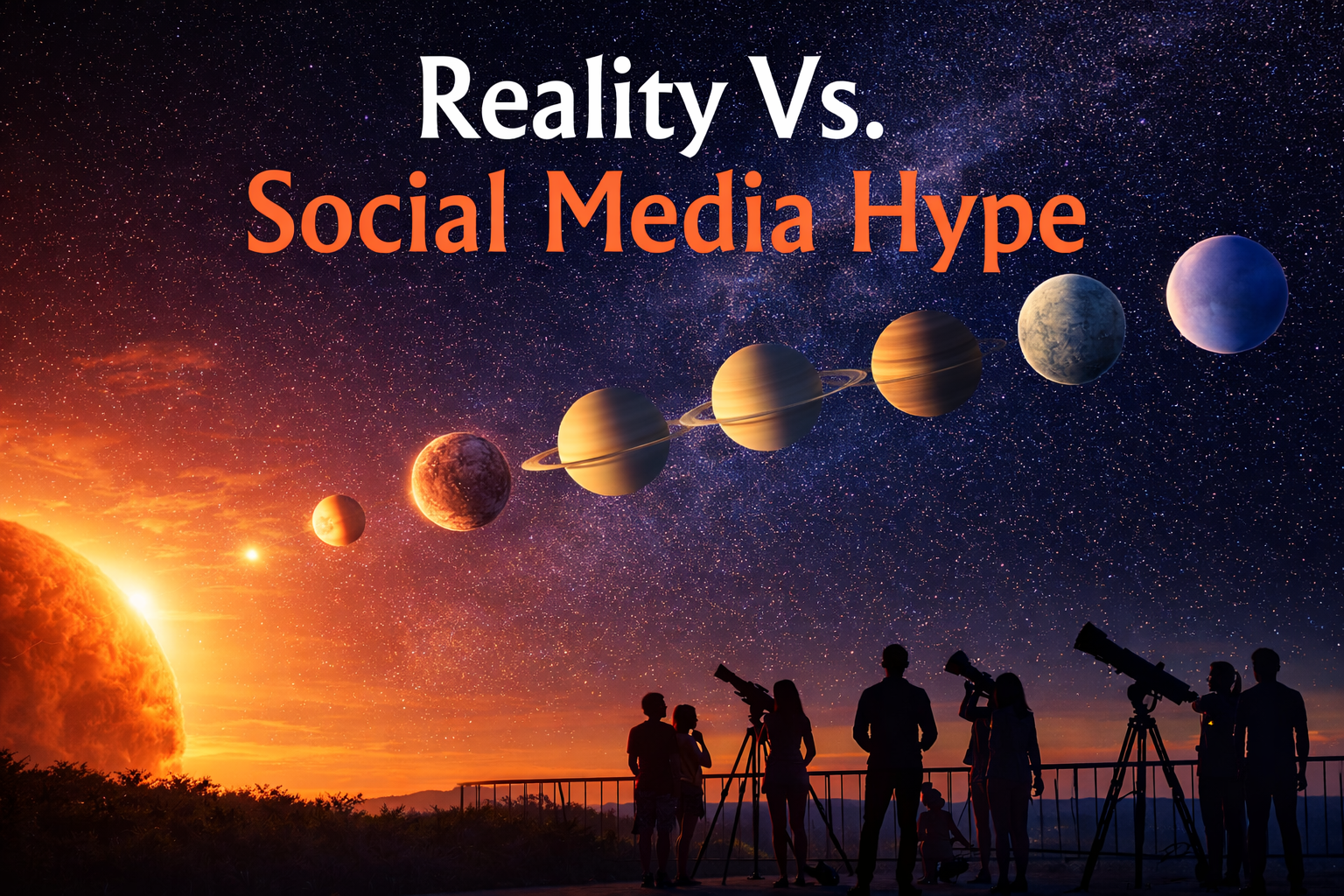
A planetary alignment occurs when several planets appear in the same region of the sky at the same time.
Importantly, planets do not form a perfect straight line in space. They only appear grouped together because we are viewing them from Earth along the plane of the solar system, known as the ecliptic.
So, alignments are more about perspective than dramatic cosmic geometry.
The Truth Behind the Viral Planet Alignment Claims
Yes, several planets will be observable in the evening sky on 28th February, but they will not be dramatically lined up as social media forwards suggest.
What makes this date genuinely interesting is when and how some planets can be observed—especially Mercury and Venus in daylight, something that is rarely attempted by amateur observers and requires precise timing and guidance.
Which Planets Will Be Visible on 28th February in the Planet Parade?
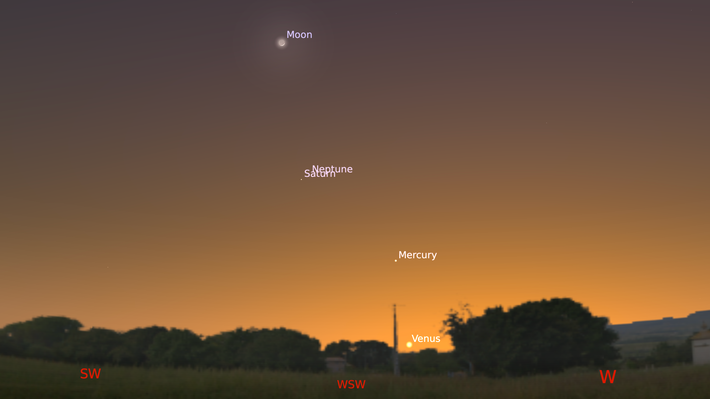
During this planetary alignment, six planets will be present in the sky, but they will not all be equally easy to observe.
Naked-Eye Planets (Under Good Conditions)
Arranged from easiest to most challenging:
- Venus (magnitude –3.9)
The brightest object in the sky after the Moon - Jupiter (magnitude –2.4)
Brilliant and unmistakable - Saturn (magnitude 1.0)
Moderately bright, visible in twilight - Mercury (magnitude 1.6) Small, subtle, and low on the horizon
→ Is This Planetary Alignment Rare?
Seeing several planets in the sky on the same evening is not extremely rare. Because all the planets orbit the Sun in roughly the same plane (the ecliptic), they frequently appear along the same stretch of sky at different times of the year. As a result, so-called “planet alignments” happen regularly, not once in a lifetime.
→ Will All Six Planets Be Visible to the Naked Eye?
 No, all six planets will not be visible to the naked eye.
Even under excellent sky conditions, only a few of them can be seen without optical aid.
Planet visibility depends on several factors, such as brightness (magnitude), distance from Earth, height above the horizon, and sky brightness during twilight.
While social media suggests that all six planets will be easily visible, only four planets are theoretically naked-eye objects, and in practice, most observers will clearly notice only Venus and Jupiter. The remaining planets require optical instruments, proper timing, and guidance to be observed successfully.
Understanding these limitations helps set realistic expectations—and makes real stargazing far more rewarding.
Final Conclusion on Planet Parade
The social media hype around the “Six-Planet Alignment on 28th February” is not a once-in-a-lifetime astronomical event. Claims circulating on WhatsApp and Instagram significantly exaggerate what will actually be visible in the sky.
In reality, for most people observing without professional equipment, only two planets — Jupiter and Saturn — will be clearly visible in the evening sky. The remaining planets are either too close to the Sun, very low on the horizon, or extremely faint, making them difficult or impossible to observe without telescopes, precise timing, and expert guidance.
What is being promoted online as a dramatic planetary alignment is not a true alignment in space, but a visual grouping created by perspective. Social media posts have turned a routine astronomical configuration into sensational content, creating expectations that do not match real observing conditions.